Published WorkShort StoriesReal LifeBackgroundEssaysAcademic

It started when I won first prize in a local writing competition in my home town (with Death walks round the world). To test the water, in 1985 I applied for a regional Arts Council bursary: if successful, I planned to start writing more seriously; if I wasn't, I'll only write when I feel like it. I did receive it, and have since built a body of work amounting to over 50 short stories (with 11 at late draft stage) and three short novels (two still in progress). Most of my writing would now be described as Speculative fiction
, a current category that has mutated from other sometimes more restrictive classifications such as magic realism and the more literary quarter of science fiction.
Published Work
After six drafts and a few test readers, I recently submitted my first novel The Waiting Place from Faber Academy and received useful and very encouraging feedback, so am currently focussing on that (and beginning to work out how to find agents) rather than short stories.
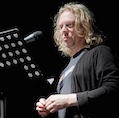
After four early stories were published in Declassified Material (1988), my focus shifted to digital art and live performance in various bands, but returned to writing around 2015, particularly after 2018 when it became a primary focus again. Some of these are available below. All but one public reading were at Short Fuse Fiction (2010 and another date I can’t recall), run by Polly Tucket at Leicester’s YMCA Theatre and other venues.
Collections
- The Box Gramarye, (Issue 28 Winter 2026)
- Red hair (short version) The Purple Breakfast Review (Issue 1, 2015) from The Student Wordsmith
- In Declassified Material (1988)
- The Arrangement
- The Ozone Boy
- Bad Electricity
- The Rain
Public Readings
- Forgotten, DeMontfort University public reading (2015?)
- Envy
- Bad Electricity
- Bald
- Experiment
- The Mole
Competitions
- Just one: Death Walks Round the World
First Prize, Melton Mowbray short story competition (1985)
Short Stories
A selection, some have been published (see above).
- The iron alarm
No-one round here says “hello”. They say “alright”, as if they care how you are or need to check that everything is as it should be, but no-one ever knows because you're just supposed to say “alright” back…
- Our special fishes
Leaning over the harbour wall I could see my uncle amongst them. Fish with human faces. The first time I saw them I was three years old, and alarmed…
- Death walks round the world
By now, death had walked calmly round the world so many times that the sea no longer took the trouble to get it wet as it crossed the ocean floor…
(This is the story than started me off. It won first prize in a little writing competition in my home town.)- Small
- Peter has to work like most of us, but although he's not quite feeling normal he finds someone who understands that the world sometimes looks like it's coming at him from the wrong end of a telescope.
- Bald
Out in the desert, they wanted to take off their clothes. She didn't stop at her clothes. She took off her hair…
- The mole
The pipes, tubes, meters and walkways gave this machinery the appearance of a pumping station I had once visited—the scale of the equipment evoked the comparison—but I knew at once that what was before me had nothing at all to do with water.
Stories and poetry from real life…
- Go through the rainy window
- for four very short stories with a melancholy edge…
- Or see poetry in a bottle
- for five poems on the same melancholy theme (opens new tab/window)
A Little Background
As a literary form, short stories were once sadly overlooked or even discounted in the UK when I began, and you often had to look to other countries in which they were valued more enthusiastically. However, until I left full-time work in 1992 they suited my extended lunch hours in Nottingham city library. They’re ideal for working in small chunks of time, although more recently I have had the luxury of focus to resume work on the three novels I began back then and one—The Waiting Place—is now almost complete after six drafts and a critical pass through Faber Academy.
I mainly keep poetry private (previously written on the portable in the photo) mainly because I don’t really think of myself as a poet, although I’ve used a few poems to illustrate one personal area of this site. I tend to move between between art, music and writing.
Although I attended Art School, I became involved in programming and computer technology shortly after it became practically available and affordable. The first thing I ever did on a (green-screen Amstrad) computer in the 80s was write short stories and create geometric graphics. My tiny Apple PowerBook 100 (their first) was my next “portable typewriter”. Nowadays I write in plain text using the beautifully minimal Markdown (originally created in 2004–Markdown guide here) which can be exported as Word, PDF and many other formats. As well as in the humanities, I formerly taught in a computer science department and acquired a few useful skills, so now store all my work in GIT repositories, which retain the entire history of each piece and its revisions.
Details of a few of the writers I like, or who have been an influence, with information on each.
Essays
Around the turn of the millennium I started thinking about using hypertext as a medium. And I do mean thinking about. For now, to view a future hypertext piece as (warning) one long page of ordinary text (that might have <link> inserted here and there), these essays—the nearest term I can find to describe them—would be a starting-point:
- New media
- A diatribe about artificial and actual distinctions between digital and material space, and the need to identify and name new experiences.
- The Heptagon
- One individual explores the significant symbolic difference between six and seven in a Euclidean quest to discover the impossibility of constructing a perfect Heptagon.
Academic Papers (selection)
Free to download at Academia.edu/DavidEveritt. For more details and authors of joint papers, follow the links.
- On physiological computing with an application in interactive art
- A discussion on the logic of the necessity for investigation into the area of physiological computing and reviews empirical work by some of the authors.
- Is creativity a ‘natural’ process?
- Argues for an examination of creativity at a lower functional level than existing cognitive-sociological models, drawing on the dynamics of self-organizing complex systems and patterns.
- Cultural anxiety 2.0
- An argument for a more intelligently informed ‘2.0’metaphor, and the anxiety behind the rapid adoption of web terminology in other fields, or whether the use of this suffix in other contexts is meaningful beyond the current phase of the web.
- Magic Square Pattern Homologies
- Using the magic line (connecting each integer in sequence) to reveal underlying homologies and to investigate whether magic squares that share magic line patterns might also be considered trivial.
- Creative Visualisation of Magic Squares
- Exploring software methods to enable the measurement of certain properties of magic squares, such as the length of the magic line and the results of certain transformations.
- Creative Zombie Apocalypse: A Critique of Computer Creativity Evaluation
- Concatenating and enhancing existing models of creativity, a proposal for a framework that takes issues regarding the evaluation of creative work that uses the computer as a medium more effectively.